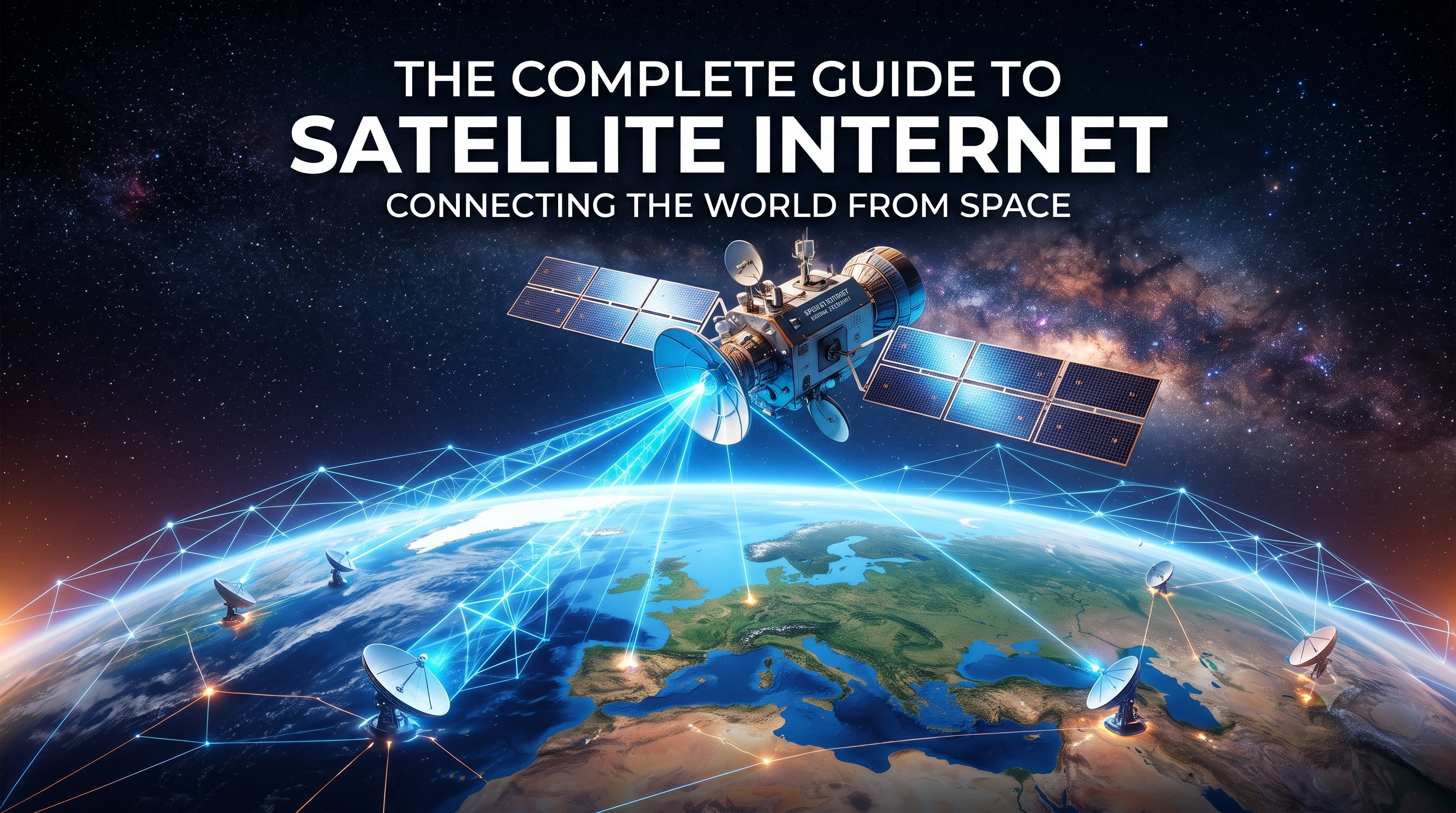
Satellite Internet: Connecting the World from Orbit
In an increasingly connected world, reliable internet access is often taken for granted in urban areas. Yet, vast swathes of our planet remain underserved or entirely cut off from the digital highway. Enter satellite internet — a technology that, while not new, is undergoing a dramatic resurgence, promising to bridge the digital divide and bring high-speed connectivity to every corner of the globe. Let's delve into how this orbital technology is reshaping our understanding of internet infrastructure.
How Does Satellite Internet Work?
At its core, satellite internet transmits data not through underground cables, but wirelessly via satellites orbiting Earth. The basic setup involves three main components:
- Satellites: These are the "relays" in space. Traditionally, geostationary (GEO) satellites, orbiting at about 35,786 km above the equator, were used. While providing wide coverage, their distance resulted in significant latency (delay). Modern satellite internet, spearheaded by companies like SpaceX's Starlink, utilizes constellations of Low Earth Orbit (LEO) satellites. Orbiting at altitudes of 500-2,000 km, LEO satellites are much closer to Earth, drastically reducing latency and enabling faster speeds.
- Ground Stations (Gateways): These are large antennas on Earth that connect the satellite network to the traditional internet backbone. Data travels from the internet to these ground stations, up to the satellites, and then down to users.
- User Terminals: Often referred to as "dishes" or "terminals," these are the devices you install at your home or business. They send and receive signals to and from the satellites, acting as your personal gateway to the satellite internet network.
The Advantages: A Global Reach
Satellite internet offers compelling benefits, particularly in scenarios where traditional broadband is impractical or impossible:
- Global Coverage: Its primary strength is the ability to provide internet access almost anywhere on Earth, including rural areas, remote islands, and even at sea, where laying fiber optic cables is prohibitively expensive or geographically challenging.
- Rapid Deployment: Setting up a satellite internet connection is generally quicker than deploying new wired infrastructure, making it ideal for temporary setups, disaster relief, or quickly connecting remote operations.
- Resilience: In regions prone to natural disasters or where existing infrastructure is fragile, satellite internet can offer a robust, independent communication channel.
The Challenges: Not Without Its Hurdles
Despite its promise, satellite internet faces several obstacles:
- Cost: Both the initial equipment purchase (the user terminal) and the monthly subscription fees tend to be higher than traditional broadband options.
- Latency (though improved): While LEO satellites have significantly reduced latency compared to GEO, it can still be higher than fiber-optic connections, which might impact real-time applications like competitive online gaming.
- Weather Interference: Heavy rain, snow, or dense cloud cover can sometimes degrade signal quality, leading to slower speeds or temporary outages.
- Line of Sight: The user terminal requires a clear view of the sky to connect to satellites, meaning obstructions like tall buildings or trees can be an issue.
- Environmental Concerns: The proliferation of thousands of LEO satellites raises concerns about space debris and potential light pollution impacting astronomical observations.
Key Players in the Orbital Race
The satellite internet landscape is competitive, with several major players:
- Starlink (SpaceX): The most prominent, utilizing a vast constellation of LEO satellites.
- OneWeb: Another significant LEO constellation operator, focusing on enterprise and government clients.
- Project Kuiper (Amazon): Still under development, Amazon's ambitious plan to deploy over 3,000 LEO satellites.
The Impact and Future
Satellite internet is more than just another way to get online; it's a critical tool for bridging the global digital divide, fostering economic growth in underserved regions, and enabling new applications in areas like maritime, aviation, and remote sensing. As technology advances, equipment costs decrease, and constellations grow denser, we can expect satellite internet to become an even more ubiquitous and indispensable part of our connected world, truly democratizing access to information and opportunities for billions.
Key Takeaways
- Satellite internet uses satellites in Earth's orbit to provide connectivity, especially to remote areas.
- Modern systems, like Starlink, leverage Low Earth Orbit (LEO) satellites to reduce latency and increase speeds significantly.
- Advantages include global coverage and rapid deployment, making it vital for bridging the digital divide.
- Challenges involve higher costs, potential weather interference, and environmental concerns regarding space debris.
- Companies like Starlink, OneWeb, and Project Kuiper are leading the charge in this rapidly evolving sector.
Be the first to leave a comment.
Leave a comment